Loading…
Plaster calculator
Plaster calculator: cement and sand for a wall or ceiling
A 10 ft × 10 ft wall (100 sq ft) plastered 12 mm thick in a 1:4 mix needs about 44.9 kg of cement, which is 1 bag of 50 kg, and 0.125 m³ (4.4 cft) of sand, with 10% wastage. Enter your wall or ceiling size, any openings to deduct, the plaster thickness and the mix below. This free plaster calculator works from the area and the thickness, and you can type your own rates to see a cost.
Free · no sign-in
Work out cement and sand for plaster
Common site thicknesses; your engineer or mason decides.
A common site mix; your engineer picks one.
Change the wastage and mortar factor
10% is common site practice for uneven walls and droppings, not a code value.
Common site practice, not a code value.
Your rates (optional)
Type your own figures to see a cost. Nirmaan does not publish cement, sand or labour rates.
Result
Enter the size of the surface to see the cement and sand.
Cost estimate only. Cement, TMT steel, sand, aggregate and bricks are shown for cost estimation only. They can't be sourced or requested on Nirmaan.
For planning only: your engineer confirms the quantities. No structural design.
Site usage runs higher than the geometric figure. Uneven walls, raked joints, mortar that falls and is lost, and thickness that varies from place to place all add up, Site usage commonly runs about 10–20% above the geometric (no-wastage) quantity (common site practice). The default 10% wastage covers the lower end; raise it if your mason expects more. This is not a code value.
Plaster quantity formula
To calculate plaster quantity, multiply the area to plaster by the thickness to get the wet volume of mortar, add wastage, convert to dry volume and split it by the mix. These are the steps the calculator follows. Nothing is looked up from a table of bags per square foot: that figure comes out of the thickness and the mix.
- Area to plaster = length × height (or the area you type) − area of doors and windows
- Wet mortar = area to plaster × plaster thickness (in metres)
- Wet mortar with wastage = wet mortar × (1 + wastage %)
- Dry mortar = wet mortar with wastage × 1.27 (dry sand and cement take more room than the mortar they make)
- Cement (m³) = dry mortar × 1 ÷ (1 + sand parts); sand (m³) = dry mortar × sand parts ÷ (1 + sand parts)
- Cement (kg) = cement m³ × 1,440 kg/m³; bags = kg ÷ 50, rounded up to whole bags
- Cement per m² (kg) = thickness (m) × 1.27 × 1 ÷ (1 + sand parts) × 1,440, before wastage
- Cost (only when you type rates) = bags × cement rate + sand quantity × sand rate + sq ft × labour rate
Assumptions (change them in the calculator)
- Thickness 6, 12, 15 and 20 mm: common site thicknesses (6 mm for a ceiling, 12 mm for an internal wall, 20 mm as the total of two coats on an external wall), not code values. You can type your own thickness. Your engineer or mason decides.
- Mixes 1:3, 1:4, 1:5 and 1:6 (cement : sand by volume): common site mixes; your engineer picks one for each surface. This is not a code requirement.
- Wastage 10%: common site practice for uneven surfaces, raked joints and droppings, not a code value. Editable. Site usage commonly runs about 10–20% above the geometric (no-wastage) quantity (common site practice). The default 10% wastage covers the lower end; raise it if your mason expects more.
- Mortar dry-volume factor 1.27: the same common-site-practice value the brick calculator uses (sites use about 1.25 to 1.33), not a code value. Editable.
- Cement 1,440 kg/m³ (the IS 875 Part 1 unit weight of ordinary cement, the same value the concrete calculator uses) and a 50 kg bag.
- 1 ft = 0.3048 m and 1 sq ft = 0.09290304 m² exactly.
Sources
- IS 875 (Part 1):1987, Table 1, item 19 (cement, ordinary: 1,440 kg/m³): law.resource.org
- 1 ft = 0.3048 m exactly: NIST Special Publication 811, Appendix B: nist.gov
Worked example: 10 ft × 10 ft wall, 12 mm, 1:4
10 ft × 10 ft wall, 12 mm plaster, 1:4 mix, 10% wastage
- Area: 100 sq ft = 9.29 m² (no openings deducted)
- Wet mortar: 9.29 m² × 12 mm (0.012 m) = 0.111 m³
- With 10% wastage: 0.111 × 1.1 = 0.123 m³
- Dry mortar: 0.123 × 1.27 = 0.156 m³
- Cement (1:4): 0.156 × 1 ÷ 5 = 0.0311 m³ × 1,440 = 44.9 kg = 0.9 bags → 1 bag
- Sand: 0.156 × 4 ÷ 5 = 0.125 m³ (4.4 cft)
- Cement per m²: 0.012 × 1.27 ÷ 5 × 1,440 = 4.39 kg (before wastage)
Plaster thickness guide
These are common site thicknesses, not code values. The right thickness depends on how even the surface is and where it is, so your engineer or mason decides. A thicker coat uses cement and sand in direct proportion: double the thickness, double the material. The figures below are for 1:4, 100 sq ft and no wastage.
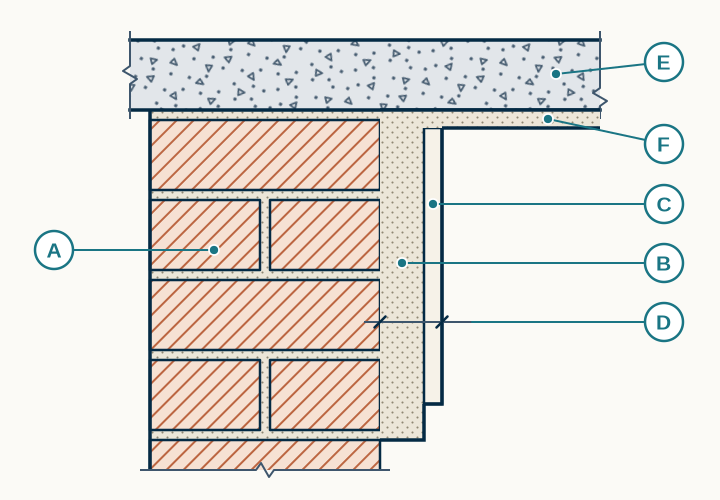
Key to the letters
- A: Brick wall (bricks hatched, mortar joints dotted)
- B: First coat, pressed into the raked joints so it grips the wall
- C: Finishing coat, where the plaster goes on in two coats
- D: Plaster thickness: the total of all the coats on one face. This is the thickness you enter in the calculator.
- E: RCC slab over the wall
- F: Ceiling plaster on the underside of the slab; work out the ceiling as a separate surface
| Thickness (mm) | Commonly used for | Cement per m² (kg) | Cement per 100 sq ft (bags) | Sand per 100 sq ft (cft) |
|---|---|---|---|---|
| 6 | Ceilings, in common practice | 2.19 | 0.41 | 2 |
| 12 | Internal walls, in common practice | 4.39 | 0.82 | 4 |
| 15 | Walls that need more levelling, in common practice | 5.49 | 1.02 | 5 |
| 20 | External walls, as the total of two coats, in common practice | 7.32 | 1.36 | 6.7 |
Where plaster goes on in two coats, the thickness here is the total of both. A thin coat on a very uneven wall will not level it: the mason fills low spots first, and that extra mortar is why site usage runs higher than the figure for the nominal thickness.
Plastering ratio guide: 1:3 to 1:6
| Mix (cement : sand) | Cement per m² at 12 mm (kg) | Cement per 100 sq ft at 12 mm (bags) | Sand per 100 sq ft at 12 mm (cft) | Commonly used for |
|---|---|---|---|---|
| 1:3 | 5.49 | 1.02 | 3.8 | A rich mix, commonly used for ceilings and where the engineer asks for a stronger coat |
| 1:4 | 4.39 | 0.82 | 4 | A common all-round mix, used on external walls and on internal walls that need a stronger coat |
| 1:5 | 3.66 | 0.68 | 4.2 | Internal walls, commonly |
| 1:6 | 3.14 | 0.58 | 4.3 | Leaner mix for internal surfaces that are not exposed, commonly |
Per 100 sq ft at 12 mm, with the 1.27 dry-volume factor and no wastage. A richer mix (1:3) uses more cement and less sand; a leaner mix (1:6) the other way round. These are common site mixes, not a code requirement: your engineer picks one for each surface, for example a richer mix where the wall is exposed to rain. Cement mortar here means cement and sand mixed by volume with water; the ratio is cement to sand, so in 1:4 there are four parts of sand to one of cement.
Which cement for plastering?
Both ordinary Portland cement and Portland pozzolana cement are commonly used for plastering, and the pack says which one it is. Which grade and type suits your wall depends on the surface, the exposure and the weather, so your engineer or mason decides. Use fresh cement that has been kept dry, and do not use lumps that will not crumble.
The calculator works in kilograms and 50 kg bags whichever cement you use. For bag weight, volume and the grades explained, see the guide below.
Before and after plastering: surface preparation and curing
- Clean the surface. Remove dust, loose material, oil and old paint or distemper so the mortar can grip.
- Roughen smooth surfaces. Smooth concrete is usually hacked or roughened, and brick joints are raked, so the plaster has something to key into.
- Wet the surface. Wet the wall so it is damp, not dripping, before the first coat. A dry wall pulls the water out of the mortar.
- Fix the guides, then apply. Fix level guides (screeds) so the thickness stays even, then apply, level with a straight edge and finish.
- Mix in small batches. Mix only as much as can be used before it starts to set, and do not add water to mortar that has stiffened.
- Cure it. Keep the plaster damp and out of strong sun and wind after it sets. How many days is for your mason or engineer to say; cutting curing short is a common cause of cracks.
What this plaster calculator does not cover
This is a planning estimate for one surface at a time. Your mason or engineer confirms the quantities, the thickness and the mix for your wall before anything is ordered or done.
Not counted: sand bulking, water, putty, POP or wall-care finishes, waterproofing additives, scaffolding, and plaster on returns, reveals and soffits unless you add that area. Deduct only the doors and windows you enter; add the area of a second surface (the other face of a wall, the ceiling) by working it out separately.
Your own rates give your own cost. Nirmaan does not publish cement, sand or labour rates, and the cost shown is only the rates you typed multiplied by the quantities, not a price for any place or material.
Frequently asked questions
How much cement is needed for plaster per sq ft or sq m?
For 12 mm plaster in a 1:4 mix, about 4.39 kg of cement per m², which is 0.408 kg per sq ft, before wastage. That is 0.82 bags of 50 kg per 100 sq ft. At 20 mm and 1:4 it is 7.32 kg per m²; at 12 mm and 1:6 it is 3.14 kg per m²; at 6 mm and 1:3 it is 2.74 kg per m². These use the 1.27 dry-volume factor.
What is the plastering ratio?
The ratio is cement to sand by volume. Common site mixes are 1:3 for ceilings or where a rich coat is wanted, 1:4 for external walls and for internal walls that need a stronger coat, and 1:5 or 1:6 for internal walls. These are common practice, not a code requirement, so your engineer picks the ratio for each surface. The calculator offers 1:3 to 1:6 and shows the cement and sand each one needs.
How do I calculate plaster quantity for a wall?
Find the area: length × height, less doors and windows. Multiply by the thickness in metres for the wet mortar, add wastage, and multiply by 1.27 for dry volume. Split that by the mix: in 1:4, one part in five is cement and four in five is sand. Cement in m³ × 1,440 kg/m³ gives kilograms, and dividing by 50 gives bags, rounded up. For a 10 ft × 10 ft wall at 12 mm, 1:4 and 10%, that is 0.111 m³ wet, 0.156 m³ dry, 44.9 kg of cement and 0.125 m³ of sand.
How do I work out the plastering cost?
Type your own rates in the calculator: the cement rate per bag, the sand rate per cft or per m³, and the labour rate per sq ft. It multiplies them by the rounded-up bags, the sand quantity and the plastered area and adds them up. Leave a rate blank and that line is left out. Nirmaan does not publish cement, sand or labour rates, so the cost is only as good as the rates you enter, which you can get from your mason or local market.
Which cement is best for plastering?
There is no single best cement. Ordinary Portland cement and Portland pozzolana cement are both commonly used for plastering, and the choice depends on the surface, the exposure and what your engineer or mason recommends. Whatever you pick, use fresh cement kept dry, measure the mix by volume and cure the plaster. The guide on cement bag weight, volume and grades explains what is printed on the bag.
How much sand is needed for plaster?
For 12 mm plaster in a 1:4 mix, about 4 cft (0.113 m³) of sand per 100 sq ft before wastage; in 1:6 it is about 4.3 cft. The calculator gives sand in both cft and m³. Sand is measured loose, and wet sand takes up more room than dry sand (bulking), which this tool does not count, so your mason may ask for more.
How thick should plaster be, and why does the site use more?
Common site thicknesses are 6 mm on a ceiling, 12 mm on an internal wall and about 20 mm in two coats on an external wall, but your engineer or mason decides. The calculator starts at 12 mm and takes your own value. Site usage commonly runs about 10–20% above the geometric (no-wastage) quantity (common site practice). The default 10% wastage covers the lower end; raise it if your mason expects more. This is not a code value.